
Light, memory and glass
At Grasett Park, a monument to compassion is built from transparency rather than stone
Public memorials have an unfortunate tendency toward the literal. Toronto's Grasett Park, designed by Denegri Bessai Studio, avoids such traps. Instead of bronze figures and grand gestures, the designers have created a place where memory is carried by light itself.
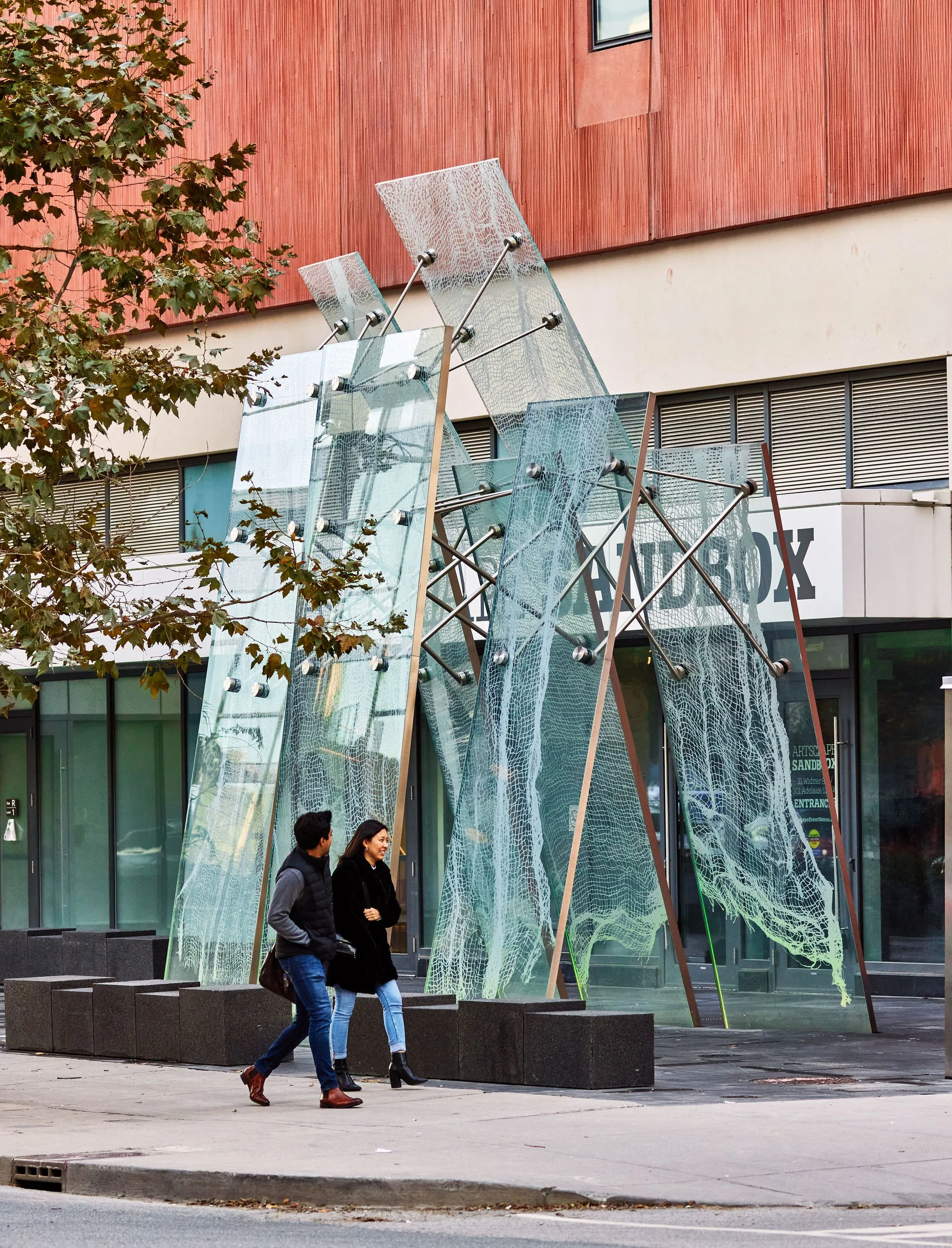
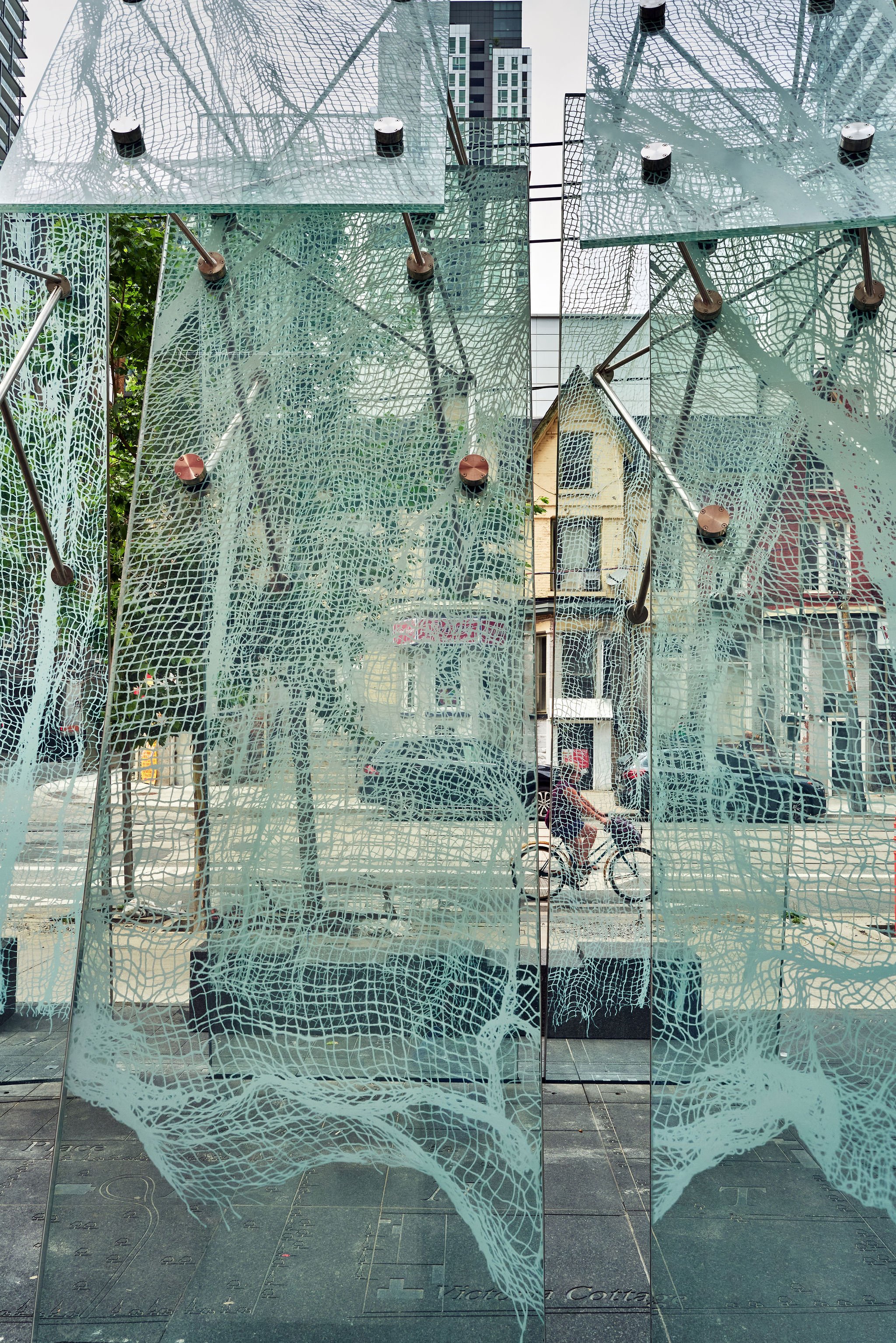
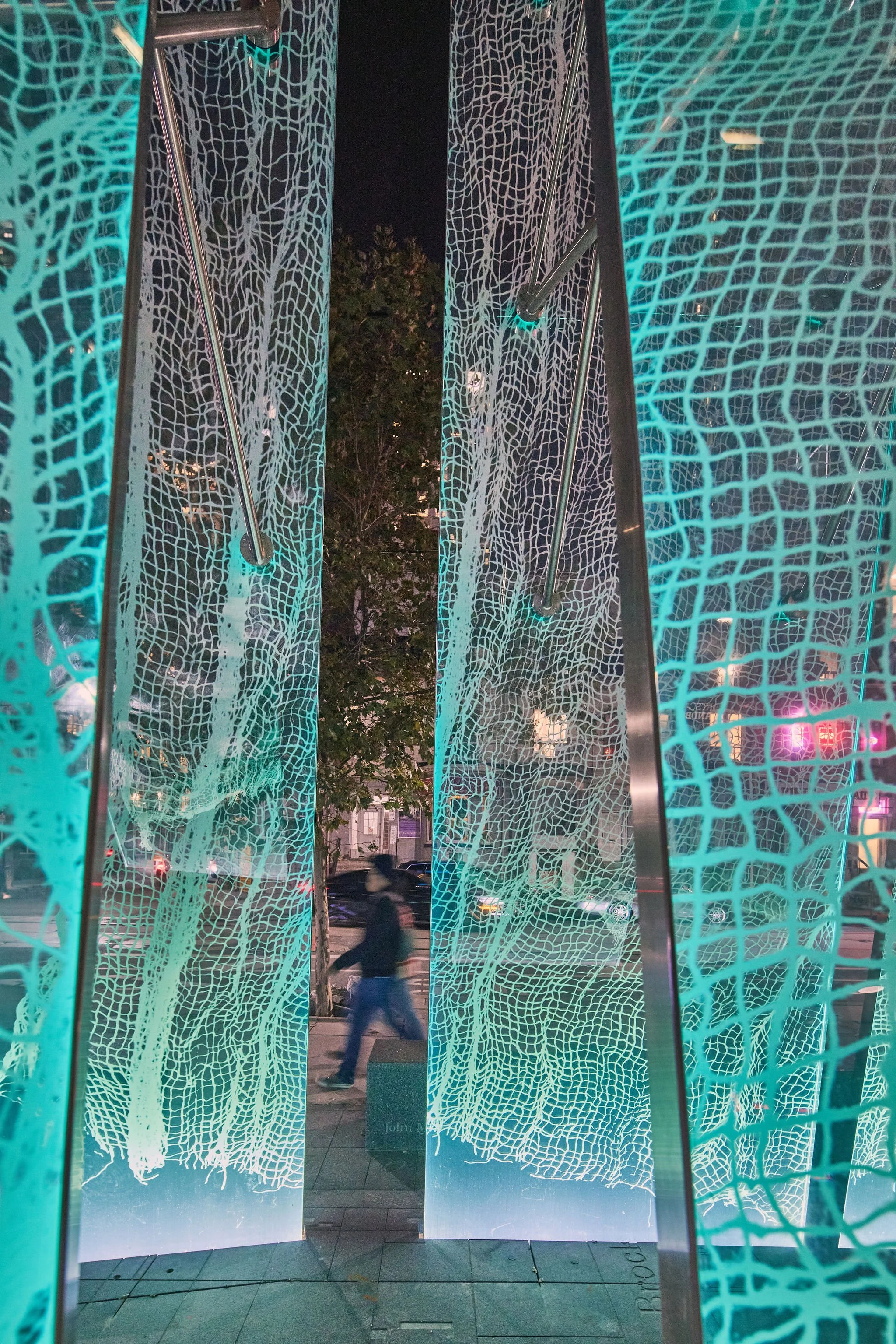
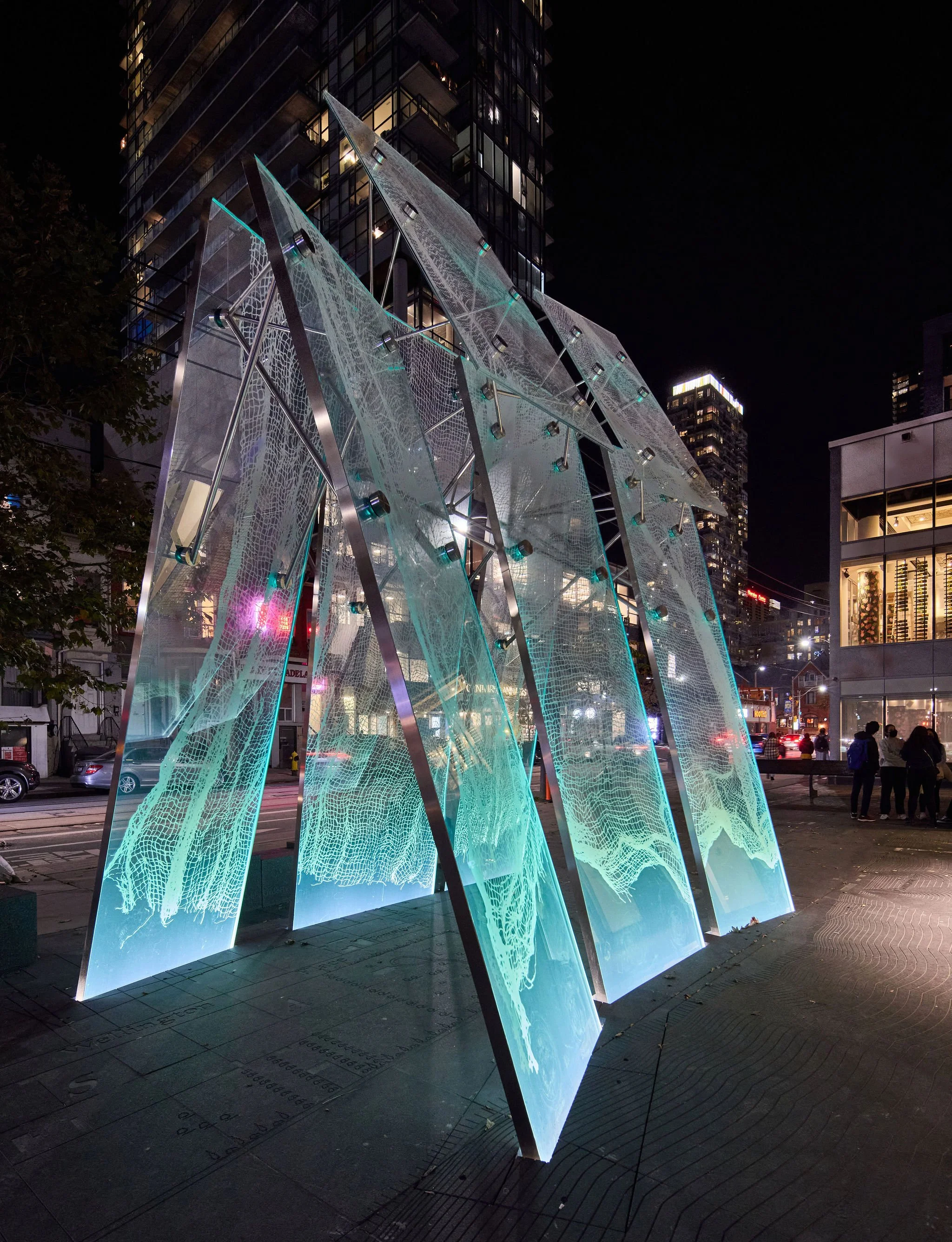
At the heart of the park, a series of tall laminated glass panels rise from a granite base like fragments of atmosphere. Their surfaces contain patterns derived from cheesecloth, recalling the improvised bandages and insect screens used in the fever sheds that once occupied the site during the typhus epidemic of 1847. The effect is understated and all the more powerful for it. Depending on the hour and the weather, the installation shifts between reflection and transparency, appearing alternately substantial and almost immaterial.
Realizing such an ethereal work demanded considerable technical sophistication. The structural glass panels were fabricated by Germany's Thiele Glass, whose expertise in architectural glass enabled the memorial's unusual combination of strength, delicacy and visual depth. Their contribution transforms the sculpture from a symbolic object into an experience shaped by changing light from day into night.
Denegri Bessai Studio deserves credit for resisting the temptation to over-explain. The memorial does not seek to overwhelm or sentimentalize. Instead, it occupies the city with a quiet confidence, allowing material, light and time to do the work of remembrance. In an age when public monuments often strive for spectacle, Grasett Park demonstrates that restraint can be the more enduring gesture.
Grasett Park: Memory Held in Glass
At the corner of Adelaide Street West and Widmer Street, a series of tall glass planes rises from a dark granite surface. They lean toward one another, overlap and catch the changing light. From some angles they resemble walls, from others, tents, sails or fragments of a building that has almost disappeared. This is Grasett Park, one of Toronto’s most quietly affecting memorials. It tells a story that reaches back to one of the most consequential public-health crises in the city’s history.
Toronto, 1847
In the summer of 1847, more than 38,000 Irish migrants arrived in Toronto while fleeing the Great Famine. Toronto itself had a population of only about 20,000. Many of the new arrivals were gravely ill with typhus after enduring overcrowded and unsanitary conditions during the Atlantic crossing and the continuing journey through the St. Lawrence and Great Lakes.
The city’s Emigrant Hospital was quickly overwhelmed. Temporary fever sheds were erected on the hospital grounds, close to where the park now stands. These were simple pitched-roof structures with open sides. Cheesecloth was hung as a makeshift enclosure, allowing air to pass through while offering patients some protection from insects.
Dr. George Robert Grasett was appointed Medical Superintendent of the Emigrant Hospital in June 1847. Known for treating people who could not afford medical care, he accepted the position despite the obvious danger. Less than a month later, on July 16, he died of typhus at the age of 36. Grasett was not alone. Other doctors, nurses, orderlies, clergy and public officials also became ill and died while caring for the migrants. Their names are engraved into the granite benches at the park.
Turning a Temporary Structure into a Memorial
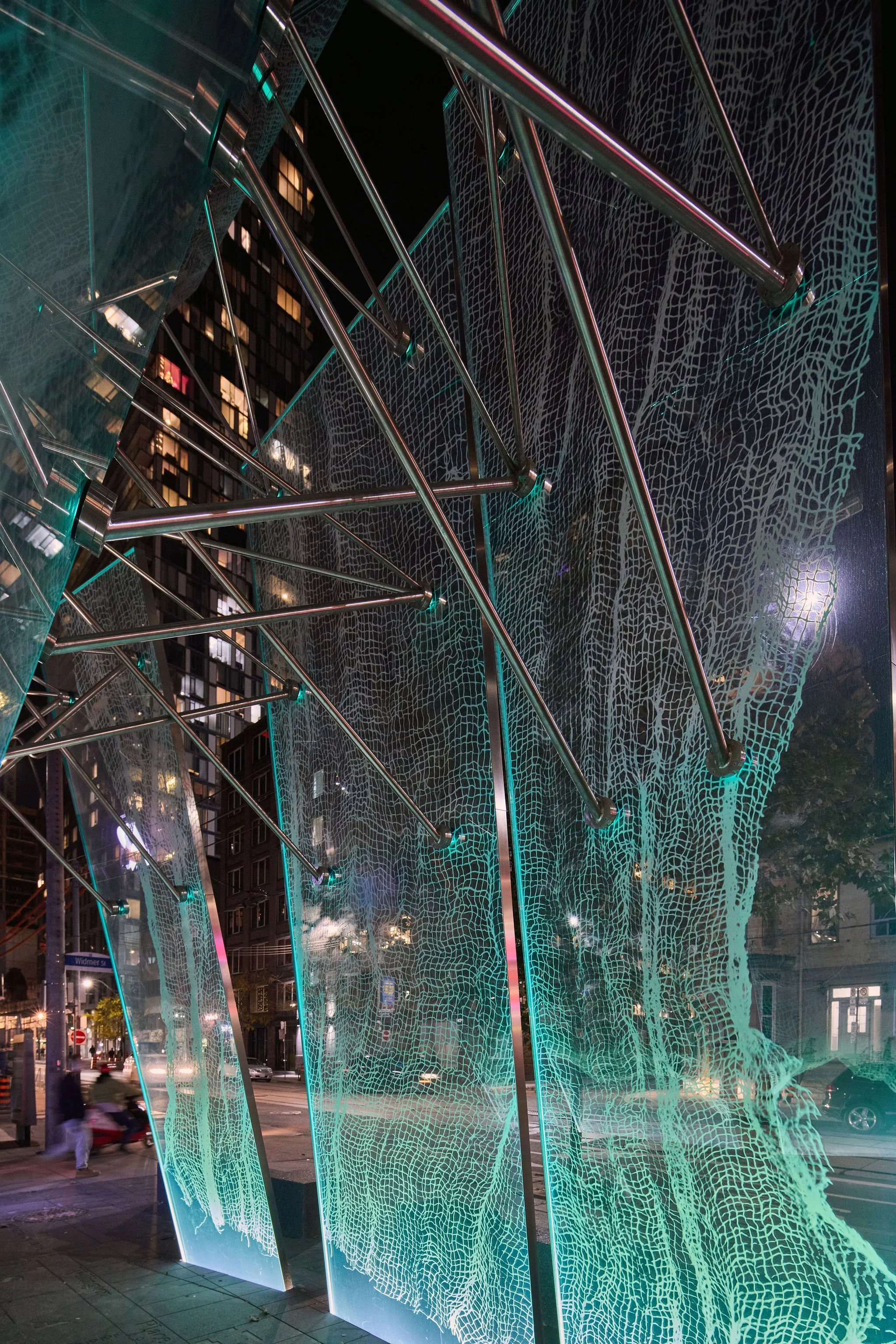
Designed by Toronto-based Denegri Bessai Studio, Grasett Park avoids the familiar language of statues and heroic figures. Its main element is an arrangement of structural laminated-glass panels. Their angled composition recalls the pitched forms of the fever sheds without attempting to reproduce them literally. The glass contains a printed pattern derived from cheesecloth. Seen during the day, the pattern can appear almost suspended within the panels. At night, concealed lighting brings it forward, making the structure glow against the surrounding brick, concrete and condominium glass.
The Craft Behind the Glass
The apparent simplicity of the memorial depends on highly specialized engineering and fabrication. These panels are not decorative sheets attached to a conventional frame. The glass itself performs structurally, with the individual planes supporting and stabilizing one another in a composition that has been compared to a house of cards. The glass was fabricated in Germany by Thiele Glas, also known as Thiele AG. Founded in 1989, the company specializes in processing and finishing architectural flat glass, including oversized laminated and safety-glass assemblies. That expertise was essential here. The panels had to combine transparency, structural strength, precise lamination and a carefully controlled printed image, all at an unusually large scale.
Thiele’s contribution is easy to overlook because successful fabrication tends to disappear into the finished work. But the beauty of Grasett Park is inseparable from the precision of its glass. The clean edges, consistent laminations and clarity of the panels allow the printed cheesecloth pattern, the city beyond and reflections of the sky to occupy the same surface. The material never settles into a single reading.
A Memorial That Changes with the City
For passersby, the park is never quite the same twice. The glass alternately reflects and reveals, becoming more solid in one light and almost disappearing in another. Pedestrians, traffic and neighbouring buildings pass across its surfaces. Grasett Park succeeds because its beauty is not separate from its purpose. The glass is fragile in appearance but formidable in construction. It recalls an improvised shelter while demonstrating extraordinary technical refinement. Most importantly, it gives permanent form to a brief but profound moment when people chose to care for strangers, despite the cost to themselves.
That is a history worth seeing and remembering.
Glass Fabrication: Thiele Glass
Architecture & Design: Denegri Bessai Studio
Design Committee: Connor Turnbull, Jonathan Kearns, John Kissick, Robert Kearns, William Peat
Historical Research: Laura Smith, PhD
Construction Management: Boszko & Verity Inc.
Structural Engineering: Entuitive
Mechanical and Electrical Engineering: Smith & Andersen
Collaborating Architect: David Lieberman
Glass Structure & Installation: Explore 1
Metal and Stone Engraving: Accents of Distinction Stone
Granite Installation: Coivic Contracting
Lighting: Xbase Electrical
All photographs © Industryous photography